
Freelancers and agencies don’t have the same social media problem
There are plenty of articles comparing social media management tools by features, pricing, and platform integrations. That’s useful—up to a point.
The bigger question is who is actually using the tool?
A freelancer managing three clients has a fundamentally different workflow from an agency managing 20.
When you’re working alone, you can keep a lot of information in your head. You know which client needs approval, which post is almost finished, and which deadline is coming tomorrow.
That stops working as the client list grows.
The best social media tool for freelancers vs. agencies should therefore be judged by workflow complexity, not feature count.
What freelancers actually need from a social media tool
For a freelancer, simplicity usually wins.
You might need to:
Plan and schedule content
Manage several social accounts
Create captions
Track basic performance
Keep a content calendar
Communicate with clients
You probably don’t need a complicated operational system for every step of the process.
If you’re the strategist, copywriter, designer, account manager, and publisher, adding unnecessary complexity can actually make your work slower.
The freelancer sweet spot
A good freelancer-focused tool should make repetitive work faster while staying easy to manage alone.
The priority is usually:
Create → schedule → publish → measure.
That’s enough for many solo operators.
What changes when you become an agency
Agency work introduces another layer: coordination.
Imagine managing 15 clients across Instagram, TikTok, LinkedIn, Facebook, YouTube, and other platforms.
Now you have multiple:
Content calendars
Brand voices
Approval processes
Team members
Deadlines
Revision cycles
Publishing schedules
Reports
The challenge isn’t simply publishing content.
It’s making sure nothing gets lost between people, clients, and systems.
That’s why an agency needs more than a social media scheduler.
An agency needs a workflow
A strong agency workflow looks something like:
Strategy → Ideas → Content → Internal review → Client approval → Revisions → Scheduling → Publishing → Reporting
If those steps happen across five different tools, your team spends a surprising amount of time moving information between systems.
And every handoff creates another opportunity for something to go wrong.
Freelancer vs agency: the features that actually matter
The difference becomes clearer when you compare what each type of user needs.
Freelancers prioritize simplicity
For a freelancer, look for:
Easy scheduling
Content creation tools
Basic analytics
Multiple account management
Affordable pricing
Minimal setup
The tool should reduce repetitive work without creating another job.
Agencies prioritize operations
For an agency, the priorities change:
Separate client workspaces
Multi-client content calendars
Client approval workflows
Internal task assignment
Team collaboration
Automated publishing
Client reporting
Brand-specific AI assistance
A centralized view of active work
The key difference is ownership.
A freelancer usually manages the work themselves.
An agency has to manage people managing the work.
That’s why a feature that seems unnecessary to a freelancer—such as task ownership or structured client approvals—can become essential at agency scale.
Don’t choose software based on the longest feature list
This is where many comparisons get it wrong.
A tool can support ten social platforms and still be a poor choice for an agency if your team spends every day chasing approvals in email.
Likewise, an agency platform can be overkill for a freelancer who simply needs to schedule posts.
The right question isn’t:
“Which social media tool has the most features?”
It’s:
“Which tool fits the way I actually operate?”
If you’re a freelancer, optimize for simplicity.
If you’re building an agency, optimize for repeatability and control.
Where GoGoHype fits
GoGoHype is built specifically around the agency side of this equation.
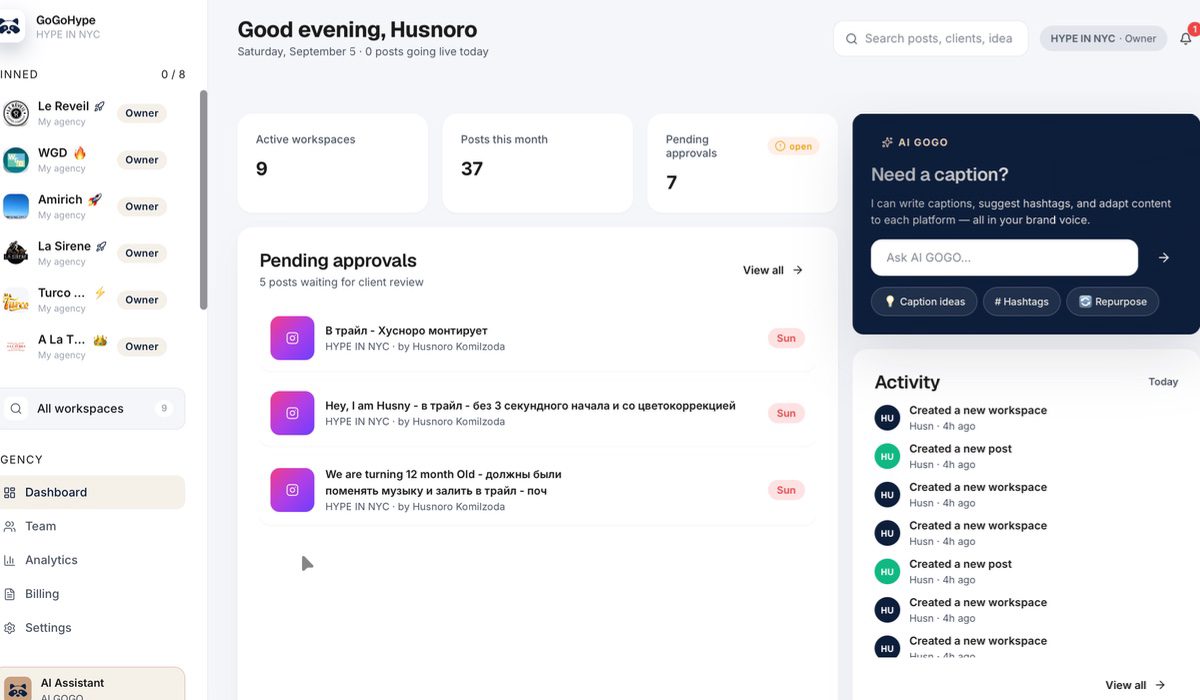
Instead of treating social media management as just scheduling, GoGoHype connects the operational pieces agencies deal with every day: client workspaces, content planning, approval workflows, team tasks, AI caption generation, analytics, and auto-publishing across eight platforms.
That matters when your biggest problem isn’t creating one more post.
It’s knowing where every client, task, approval, and piece of content stands right now.
For a freelancer, a simpler scheduler may be all you need. For an agency, the ability to run the entire client workflow from one place becomes much more valuable.
The bottom line
The best social media tool for a freelancer and the best social media tool for an agency aren’t necessarily the same product.
Freelancers need efficiency. Agencies need efficiency at scale.
If you’re still managing a small number of clients yourself, choose the tool that keeps your workflow simple.
But once you’re coordinating multiple clients and team members, start looking beyond publishing. Your software should help you manage the entire system behind the content.
If that’s where your agency is heading, GoGoHype is worth a look. It was built for the point where managing social media stops being a solo task and becomes an operational process.