
Sprout Social vs Buffer for Agencies: What Actually Matters
Choosing between social media platforms is easy when you’re managing one brand.
Agency life is different.
You might have 15 clients, several account managers, designers, strategists, and clients who all want to review content before anything goes live. Suddenly, the question isn’t simply “Which tool has better scheduling?”
It’s “Which workflow creates less operational work for my team?”
Sprout Social and Buffer approach that problem differently. Buffer positions itself around flexible, channel-based management for growing teams and agencies, while Sprout Social has a broader enterprise-oriented system covering publishing, engagement, analytics, listening, and collaboration. (Sprout Social)
Buffer vs Sprout Social: The Core Difference
Buffer is relatively straightforward: connect the channels you manage, create content, collaborate with your team, and publish.
Its agency offering uses per-channel pricing rather than per-seat pricing, with unlimited team members on its agency-focused setup. Buffer currently supports 11 social platforms, including Instagram, Facebook, LinkedIn, TikTok, YouTube, Pinterest, Threads, and others. (Buffer)
Sprout Social takes a broader approach.
Its platform combines publishing with engagement, reporting, social listening, competitive insights, and more advanced team workflows. Its current plans range from $199 per seat/month for Standard to $399 per seat/month for Advanced, with higher-level enterprise options available. (Sprout Social)
That pricing structure matters for agencies because adding people and adding clients are two very different types of growth.
What Agencies Should Actually Compare
1. Client approvals
This is where a lot of agency workflows break.
A scheduler can publish perfectly and still leave your team drowning in emails, Slack messages, screenshots, and “can you change this one sentence?” requests.
Sprout Social supports collaborative content calendars and structured approval workflows, including external stakeholder approval on its Advanced plan. (Sprout Social)
Buffer also offers team collaboration and approval workflows through its agency/team setup. (Buffer)
The important question isn’t whether a platform has an approval feature.
Ask how many steps your team needs to get from draft to approved post.
2. Team economics
Buffer’s channel-based model can make sense when an agency has many people working across a relatively predictable set of client channels.
Sprout’s per-seat structure is different. Its advantage is a deeper collection of capabilities for teams that need sophisticated engagement, reporting, listening, and operational controls. (Sprout Social)
So don’t compare only the monthly subscription.
Calculate your actual cost based on clients + channels + employees + required features.
3. Reporting and insights
If your clients expect serious reporting, Sprout has a deeper analytics and listening ecosystem, including competitor insights and social listening capabilities on higher plans. (Sprout Social)
Buffer focuses more heavily on publishing, analytics, collaboration, and keeping the workflow relatively simple. (Buffer)
That difference becomes important when reporting is part of what your agency sells—not just something you check internally.
The Question Most Comparisons Miss
Don’t ask:
“Which platform has more features?”
Ask:
“Where does my team’s work still happen outside the platform?”
If your strategists plan in one place, writers create somewhere else, clients approve through email, tasks live in Slack, and publishing happens in another tool, you don’t have one workflow.
You have a collection of handoffs.
That’s where an agency can lose hours every week.
Where GoGoHype Fits
GoGoHype is built around that agency problem.
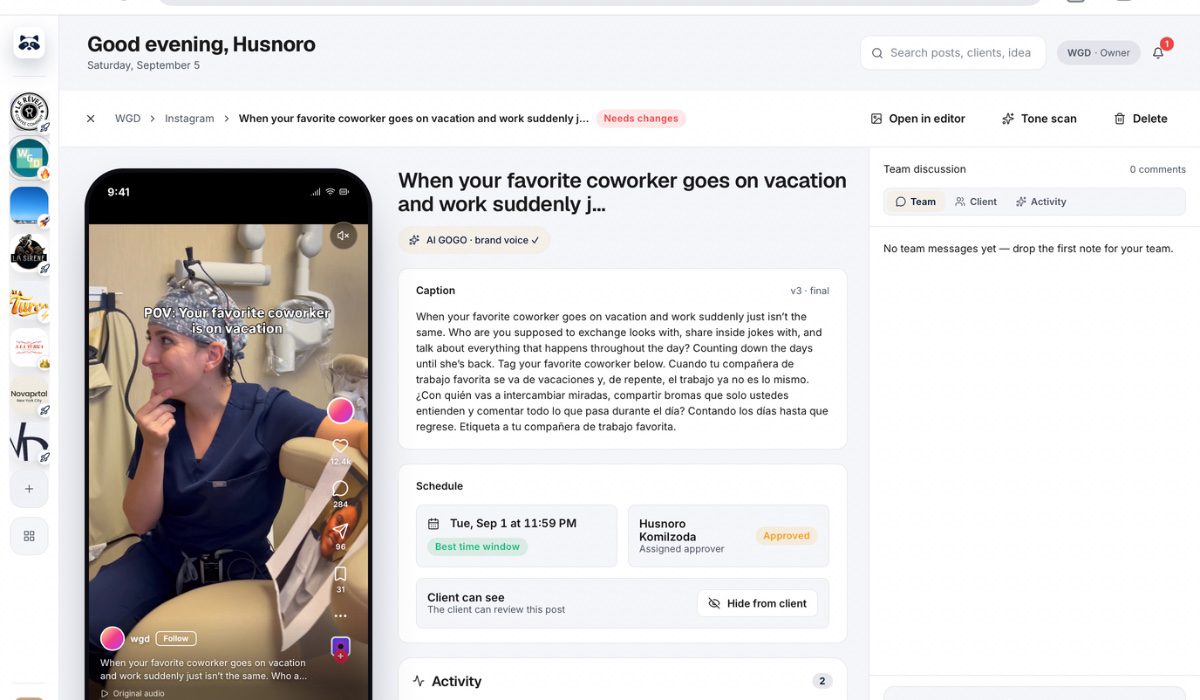
Instead of treating publishing as the entire workflow, GoGoHype brings multiple client management, content approvals, AI caption generation, team tasks, and publishing across eight platforms into one system.
The goal isn’t to replace human strategy with automation.
It’s to remove the repetitive coordination surrounding that strategy.
For an agency, that distinction matters. Your team should spend its time deciding what a client needs to say—not chasing someone for approval on a caption that was finished yesterday.
Sprout Social vs Buffer: Which Workflow Fits Your Agency?
There isn’t one universal answer.
If your agency needs a broad enterprise social management system with advanced engagement, listening, analytics, and reporting capabilities, Sprout Social’s feature set is designed around that complexity. (Sprout Social)
If your priority is straightforward publishing, collaboration, and channel-based scaling with a simpler operating model, Buffer takes a different approach. (Buffer)
But before choosing either, map your actual workflow from brief → content → internal review → client approval → scheduling → publishing.
Then look at every manual handoff.
That’s usually where the real cost of your social media software is hiding.
If you want to bring those moving parts into one agency workflow, explore how GoGoHype can fit into your team’s process.